
Guides
How to plan mobile detailing services packages in six steps
Use six steps to plan mobile detailing services packages, from stage timing and scope breakpoints to tier boundaries, van capacity, and booking reviews.
Mobile detailing services packages are a timing decision before they are a marketing one. What follows is a six-step build for a tier ladder: record your stage times, find the breakpoints, name each tier by the outcome the buyer gets, set the boundaries in writing, check every tier against what the van can carry, then publish and cut.
What to take away
- Build the ladder from your recorded stage times first. Naming the tiers before timing the work produces packages you lose money on.
- A tier only earns its place if a customer can tell, in one sentence, why they would buy it instead of the one below.
- The gap between tiers should be a visible outcome, not a longer list of steps.
- Write exclusions and the worse-than-described clause before publishing anything.
- Test the ladder on real bookings for a limited period, then cut whatever nobody chose.
Step 1: Time your own stages
Before any tier is named, record how long each stage actually takes on your kit, in a driveway, on vehicles of different sizes and conditions. Wheels and tires. Exterior wash. Decontamination. Single-stage polish. Interior vacuum and dry work. Extraction. Glass. Protection. Setup and teardown separately from all of it.
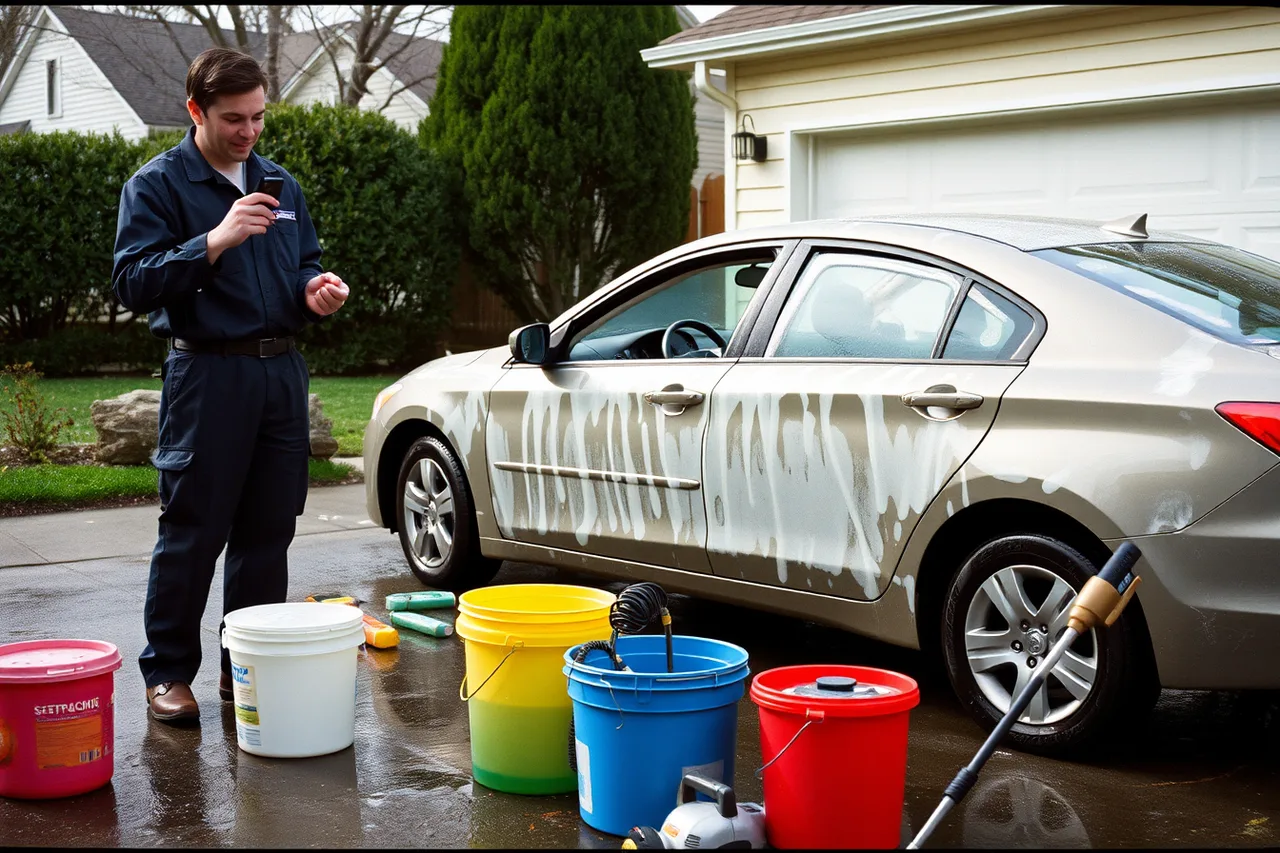
Ten to fifteen jobs is enough to see the spread. The spread is the useful part: it tells you which stages are predictable and which are hostage to condition.
Step 2: Find the natural breakpoints
Look at the recorded times and find where the curve steps rather than slopes. In most operations there are three steps: the point where decontamination is added, the point where any machine correction is added, and the point where extraction is added on the interior side.
Those steps are your tier boundaries. They are boundaries because they change the length of the visit materially, which is what a customer is really buying and what your route can or cannot absorb.
Step 3: Name tiers by outcome, not by contents
A tier called Premium tells a buyer nothing. A tier described as keeps a well-kept car well-kept, or brings back a car that has been neglected for a year, sorts buyers without a conversation.
For each tier, write one sentence: who it is for, what the car will look like afterward, and how long I will be here.
If the sentence needs a list to make sense, the tier is not distinct enough yet.
The reasoning is simple: grouping by intention rather than by task list keeps the buyer deciding on the result, not on whether they think they need extraction.
Step 4: Set the boundary of each tier in writing
For every tier, four lists:
- Included, stated as outcomes with the stages that produce them.
- Excluded, stated bluntly. Defects that will remain. Tears, burns and wear that will not be repaired. Anything requiring disassembly.
- Required from the customer, meaning access, space, and whether the vehicle needs to be empty.
- The worse-than-described rulewhat happens, and who decides, when the vehicle on arrival is not the vehicle described at booking.
That last one is the clause that prevents the argument. Decide it now, in an office, rather than later, in someone's driveway with a technician's day already running late.
Anything you claim about the result is an advertising claim. The FTC's Truth in Advertising guidance sets the standard: a claim must be truthful, not misleading, and backed by evidence you hold before you publish. That rules out most of the words that suppliers put on labels.
Step 5: Check each tier against capacity
A tier that cannot be delivered twice in a day, or that empties the water tank on one vehicle, is a constraint dressed as a product. Check each against three limits: hours of daylight, gallons carried, and the drive time between the stops you would realistically pair it with.
Water is the one operators check last and should check first. The EPA's WaterSense treatment of vehicle washing describes fixed facilities metering use by wash stage and recycling between vehicles.
A van carries a fixed supply and cannot, so the highest-water tier effectively sets the number of jobs per refill. Kit decisions behind that limit are in the equipment and setup guide.
Step 6: Publish, then cut
Run the ladder for a defined period, covering a seasonal swing, not a good fortnight.
Track four things per tier: how often it was chosen, how often it ran over the planned time, and how often it was upgraded or downgraded on arrival. Then track what it contributed per hour on site.
The method is contribution per hour: the tier's revenue less its direct costs, divided by the hours it takes on site. That is the number that decides which tier keeps its slot in the day.
Then cut. A tier nobody selected is not a fallback, it is clutter that slows every other buyer down. Keep the records that support the review, which the IRS describes as a system that clearly shows income and expenses with the documents behind them.
What to do about custom requests
Custom work is not a failure of the ladder. It becomes a problem only when it is quoted casually. Handle it with a fixed procedure: written scope, stated assumptions, a price that reflects the unknowns, and an explicit note of what happens if the assumptions are wrong.
If the same custom request appears repeatedly, it is a package you have not written yet.
Common questions
Should the top tier be one nobody buys?
A deliberately unsellable tier is a pricing trick, and customers who notice it stop trusting the rest of the page. A top tier should be a real service you would be pleased to deliver twice in a week.
How do I handle a customer who wants a tier stripped down?
Offer the tier below plus a named add-on. Stripping a tier destroys the time estimate the tier was built on, and you will absorb the difference.
Do add-ons belong inside tiers or outside them?
Outside, if their time varies with condition. Pet hair, odor and heavy staining all vary enormously and should never be folded into a fixed tier price.
When does a residential ladder stop working?
When most revenue comes from repeat commercial accounts, the pricing conversation is about routes and access windows, not tiers. That ground is covered in the expansion and market guide and the hiring that must come with it.
A second technician must deliver the same ladder to the same standard, as detailed in how to hire reliable staff.