Guides
How to judge which markets suit a mobile detailing business: nine signals to score
A market for mobile detailing cannot be ranked from a page, so here is a scoring worksheet with nine signals you can observe by driving the area yourself.
What to take away
- No city list appears here. A market that suits a one-van interior specialist can be hopeless for a correction business, so a ranking would be wrong for most readers.
- What works instead is a scoring worksheet you complete by observation, in a weekend, for any area you are considering.
- Parking type is the first filter and the harshest. No private space to work means no work.
- Water restrictions close some areas to some methods entirely. Check before anything else.
- Score two or three candidate areas against each other, not against an absolute standard.
Why no list of cities
A ranking of markets would need consistent local data on vehicle density, parking type, competing supply and water rules for every area named. That data does not exist in one place, and the pages that publish such rankings are working from population figures and enthusiasm.
There is also a definitional problem. The best market depends entirely on what you sell. Dense older housing with lived-in vehicles is excellent for interior recovery work and poor for coating work. A wealthy area of newer vehicles is the reverse. Ranking markets without naming the service is meaningless.
The worksheet
Score each signal from one to five for each candidate area. Complete it by driving the area on a weekday morning and again on a Saturday, not from a screen.
Nine signals to score
- Private working spacedriveways, room beside vehicle
- Water permissionrules, ordinances, containment
- Vehicle density per streetcount candidates
- Condition mixnewer maintained vs older lived-in
- Fleet concentrationliveried vans, dealerships, rentals
- Drive time across areatime at working hours
- Existing supplyfixed washes vs mobile operators
- Seasonalitysalt, pollen, dust, wet seasons
| Signal | What you are looking for | Weight |
|---|---|---|
| Private working space | Detached housing with driveways, room to work beside the vehicle | Highest |
| Water permission | Association rules, complex policies, local ordinances on washing | Highest |
| Vehicle density per street | How many candidate vehicles within a short walk | High |
| Condition mix | Newer and maintained against older and lived-in | High |
| Fleet concentration | Liveried vans, dealerships, rental branches, service contractors | High |
| Drive time across the area | How long to cross it at working hours | High |
| Existing supply | Fixed washes and mobile operators, counted separately | Medium |
| Seasonality | Salt, pollen, dust, coastal salt air, long wet seasons | Medium |
| Property management concentration | Managed complexes and business parks, which can be gatekeepers or gateways | Medium |
Two signals carry the highest weight for the same reason: each can close an area outright regardless of how the others score.
Signal one: private working space
Walk a few representative streets and count. Private driveways with room beside the vehicle are workable. Permit-only street parking, structured parking and tight terraced frontage are not, or only with a site agreement.
This is a physical constraint, not a marketing one, and no amount of demand overcomes it.
Signal two: water permission
Some areas restrict vehicle washing at residential addresses, some managed properties prohibit it outright, and local requirements for wash water containment vary. Ask the local stormwater office and read the rules of the larger managed properties before committing.
A low-water method can open an area a pressure-based method cannot enter. Measuring your own use per vehicle tells you whether that is possible. The EPA's WaterSense breakdown of vehicle washing shows which stages consume most and are worth cutting.
What the van can carry and deliver is settled in the equipment and setup guide. The permissions are chased through the licensing and compliance guide.
Signal three and four: density and condition
Density decides your drive time, which decides your paid hours. Count candidate vehicles per street rather than estimating population.
Density and condition service mix
Older lived-in vehicles
- Service type
- Interior recovery
- Weather exposure
- Weather independent
- Pricing basis
- Priced on condition
- Equipment
- Different lists
Newer maintained vehicles
- Service type
- Maintenance and protection
- Weather exposure
- Weather exposed
- Pricing basis
- Price sensitive
- Equipment
- Different lists
Condition decides your service mix. Older, harder-used vehicles pull interior recovery work, which is weather independent and priced on condition. Newer vehicles pull maintenance and protection work, which is more weather exposed and more price sensitive.
Neither is better. They are different businesses, and the equipment lists differ.
Signal five: fleet concentration
Drive a business park and count vehicles with a company name painted on the side. Each is a potential recurring account, and recurring accounts are what make a route predictable.
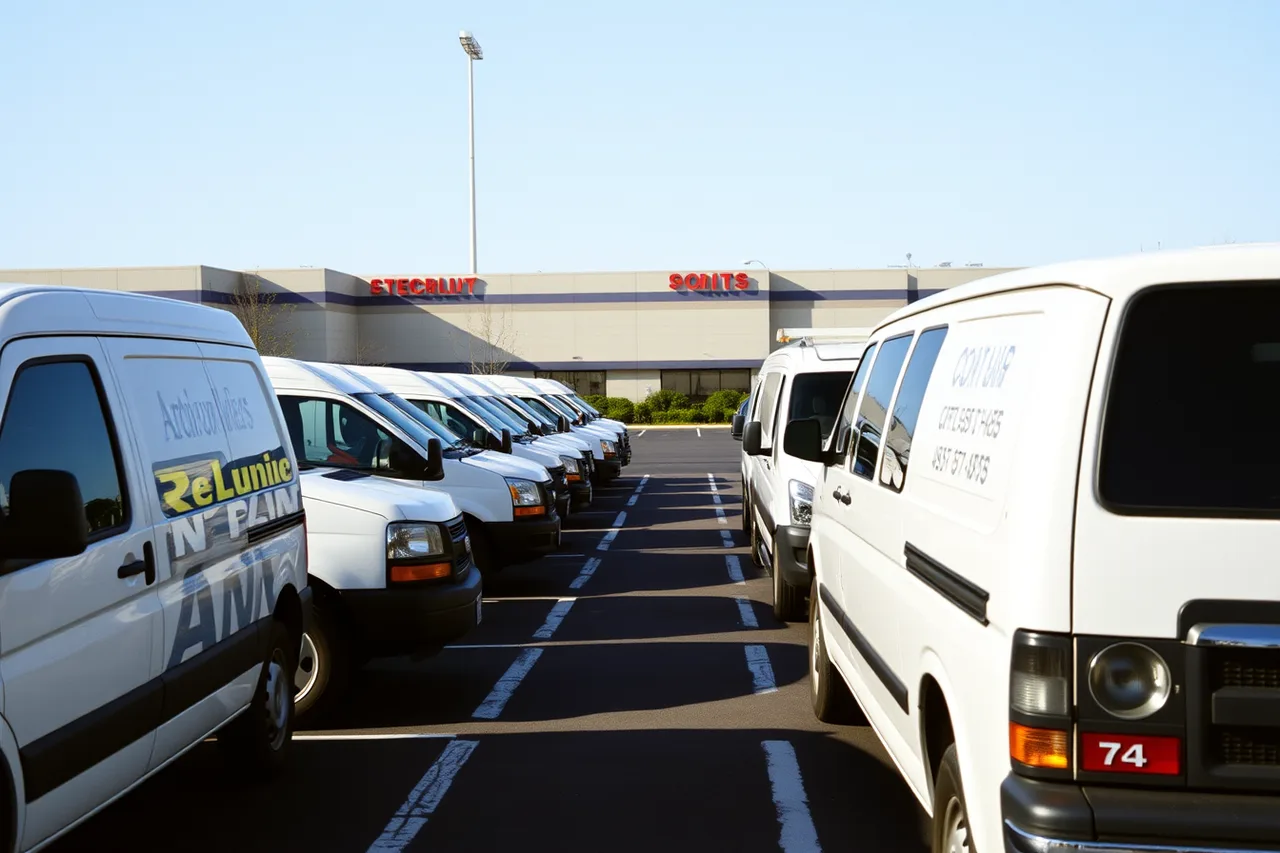
Fleet work also changes what you need: invoicing on terms, evidence of insurance, scheduled site access, and enough cash to work weeks ahead of payment.
Signal six: drive time across the area
Time it yourself at working hours. A river crossing, a single congested corridor or a rail line can make two neighborhoods that look adjacent effectively separate territories.
This is the signal that most often overturns a decision made from a map.
Signal seven: existing supply, counted properly
Fixed washes and mobile operators are not the same competitor. A dense area with several fixed washes and no mobile operators may be excellent. An area with three established mobile operators and no fixed supply is harder than it looks.
Look at what the existing operators do not do. Interior specialists, weekday-only availability and unserved commercial clusters are all openings.
Signal eight and nine: seasonality and gatekeepers
Seasonality tells you when cash will be tight, which is a planning input rather than a reason to reject an area. Write down the local trigger: salt, pollen, dust, or a long wet run.
Property management concentration cuts both ways. A managed complex can refuse you outright, or a single agreement can deliver a cluster of vehicles in one location. It is worth one conversation before scoring the area.
Scoring, and what to do with the result
Complete the worksheet for two or three candidate areas. Then look not at the totals but at the two highest-weighted rows: if either scores poorly, the area is closed regardless of the rest.
Where an area scores well, the next questions are about capacity, not demand. Can you fill a route there without a second van? If not, is the training ladder ready to produce someone who can run one?
Those are questions for how to hire reliable staff and the hiring and training guide. The sequencing of any move into a new area belongs with the expansion and market guide.
Two external inputs worth using
Local wage estimates by occupation and metropolitan area are published in the Bureau of Labor Statistics employment and wage tables, which tell you what labor is likely to cost if you staff the area. The SBA's business guide covers the market research and planning sequence around a decision of this size.
Neither will tell you whether a specific area works. Only the worksheet does that, because only the worksheet is about your service and your van.
Common questions
Is a wealthy area always better?
No. Wealthy areas often have newer vehicles in better condition, which suits protection work and disappoints anyone selling interior recovery. They also frequently have more competition already present.
Should I move to a better market?
Rarely. The cost of rebuilding a customer base usually exceeds the gain, and the same effort spent filling the route in your current area returns more.
How large should a territory be?
Small enough that crossing it does not consume a job's worth of time. Density, not size, is what produces a good week.
What if my area scores badly on everything?
Then the answer may be a different service mix rather than a different area. Interior-led work survives conditions that defeat exterior-led work, and it needs less water and less space.