Guides
Eight phases to start a mobile detailing business, each with a spending gate
Eight phases for launching a mobile detailing business, from choosing a buyer and testing the territory to a timed practice run, with a gate before each spend.
What to take away
- Order matters more than budget. Most failed launches bought equipment in phase one and studied the territory in phase five.
- Each phase ends with a gatea condition to meet before money moves to the next phase.
- The single most useful pre-launch exercise is detailing eight vehicles for free under real driveway conditions and timing every minute.
- Registration, insurance and wash-water handling get settled before the first paying customer, not after the first complaint.
- Nothing here replaces advice from a local accountant, insurer or stormwater office, because those answers change by jurisdiction.
Phase 1: Decide who the vehicles belong to
Residential owners, commercial fleets and dealerships buy different things. Residential buyers pay for a result they can see. Fleet buyers pay for a schedule they do not have to think about. Dealerships pay for turnaround speed and will squeeze the rate to get it.
Pick one as the primary buyer. The choice governs the equipment and setup decisions that come later, because a fleet route needs throughput and an enthusiast client needs lighting and time.
Gate: a written sentence naming the primary buyer and the specific problem they are paying to remove.
Phase 2: Test the territory on foot
Drive or walk the target area on a weekday morning and again on a Saturday. Count private driveways against permit parking. Note apartment complexes with posted washing restrictions. Photograph the liveried vans of local trades, because those are fleet prospects with a name already painted on the side.
Gate: a named list of at least twenty realistic first customers, not a demographic profile.
Phase 3: Settle the water question
Decide, before buying a tank, how water arrives and where it goes. The options are a carried tank with rinseless methods, a carried tank with contained rinsing, or a written agreement to use the customer's supply. Runoff into a storm drain is the failure mode that draws regulatory attention, and the rules are local.
In the United States the rule usually arrives as a municipal stormwater permit, the NPDES MS4 permit that many cities hold. A city with one may treat soapy runoff as an illicit discharge, so the wash water goes to containment or to the sanitary sewer.
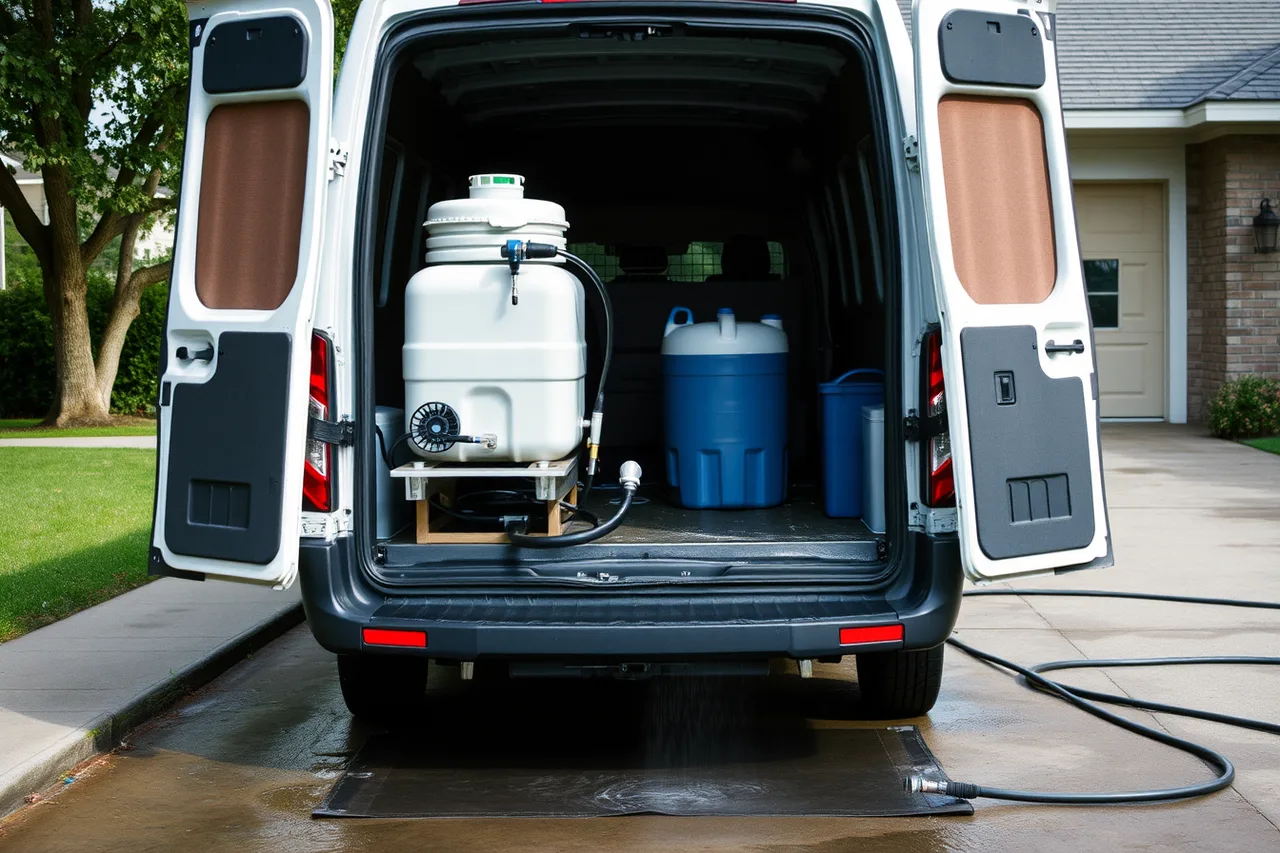
The EPA's WaterSense material on vehicle washing describes how fixed wash sites measure water by wash stage and reclaim it between vehicles. A van has no reclaim loop, so the equivalent discipline is measuring gallons per vehicle and cutting the pre-rinse.
Gate: a one-paragraph written method for water supply and wash-water containment that the local stormwater office has seen or answered a question about.
Phase 4: Register, insure, comply
Business registration, tax identification and any local trade permit come first, because several later steps require the registration number. Commercial auto coverage is not the same as personal auto coverage, and care-custody-and-control exposure for a customer's vehicle is a separate conversation with an insurer.
The IRS overview of what a new business has to set up covers structure, identification numbers and the recordkeeping obligation that starts on day one. Local requirements sit alongside it, and the licensing and compliance sequence is where those get chased down.
Gate: registration issued, insurance bound with the mobile use disclosed in writing, and a dated file holding both.
Phase 5: Build the kit around one repeatable service
Buy for the service that will be sold most often, not for the service that looks most impressive. A maintenance wash and a full interior reset can be delivered with far less capital than multi-stage correction, and they build the route that pays for the rest.
Gate: every item bought can be named as necessary to a service already on the price list.
Phase 6: Detail eight vehicles for nothing
This is the phase most often skipped and the one that saves the most money. Do eight vehicles of varying size and condition, in real driveways, with the real kit. Time arrival, setup, each stage, teardown and departure separately. Note every item you had to go back to the van for.
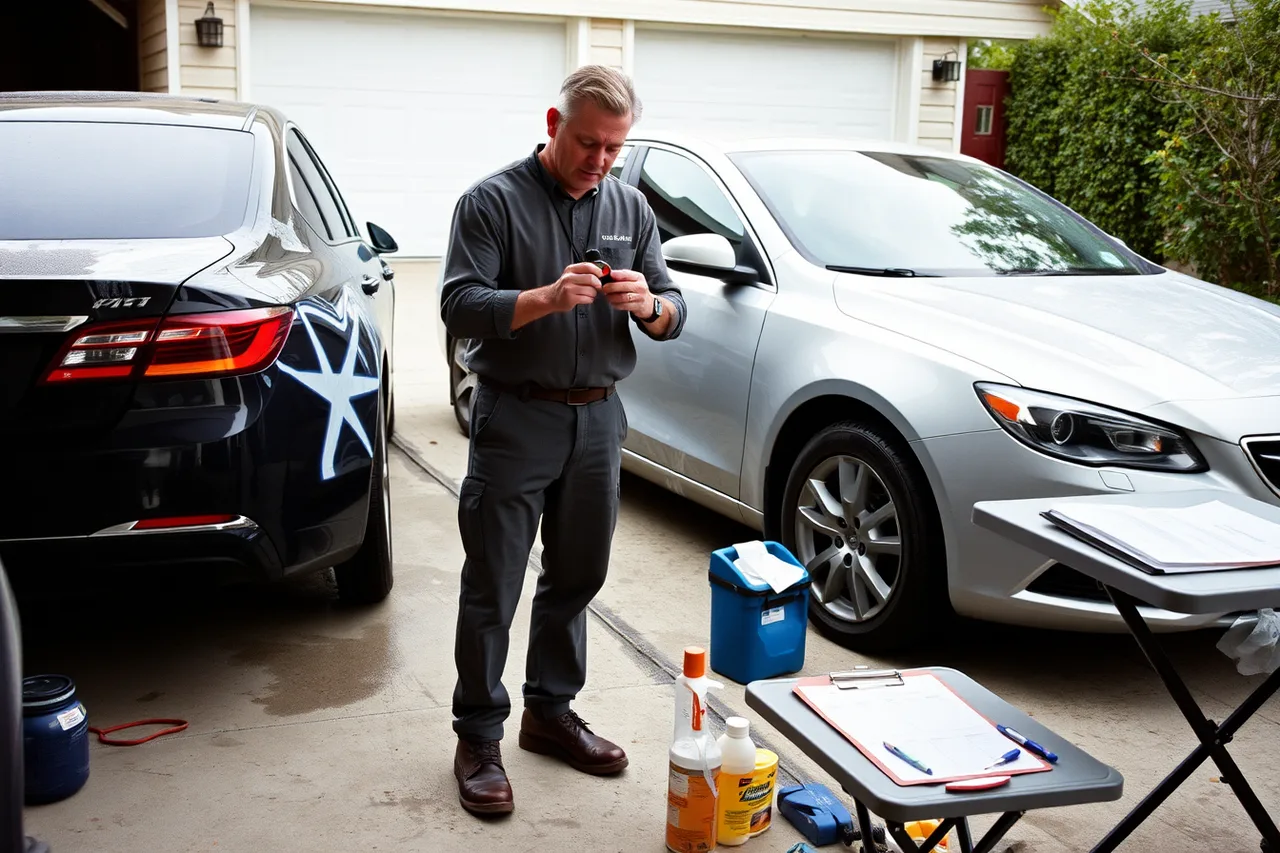
Eight is enough to see the variance. It will show that condition, not size, drives the clock, and that setup and teardown are a larger share of the day than expected.
Turn the sheet into a price. Take the minutes for one service, setup and teardown included, and multiply by your target hourly rate. Add product cost and travel. A maintenance wash that takes 90 minutes at a $60 target rate has a floor of $90 plus product and fuel. Price below that and the long vehicles eat the week.
Gate: a timing sheet showing real minutes for at least three service types.
Phase 7: Write the route, not the calendar
A day of detailing is a route with jobs attached, not a list of appointments. Group by geography, put the longest job where a delay hurts least, and hold a buffer for the vehicle that turns out worse than described. The daily workflow and handoff design is where this becomes a written standard rather than a habit.
Gate: one full simulated day, booked and timed, that finishes inside daylight.
Phase 8: Open the book and start asking
Only now does promotion make sense, because only now can a promise be kept. Early demand comes from neighbors of completed jobs, from the fleet prospects photographed in phase two, and from asking every satisfied customer a specific question rather than a general one. That is the ground the marketing and growth work is built on.
Hiring waits. A second pair of hands multiplies whatever standard already exists, including a bad one, which is why the hiring and training decisions belong after the standard is written down.
Gate: three consecutive fully booked days completed without a return visit.
Startup capital, phase by phase
These are typical planning ranges, not quotes. Local fees, the vehicle and the kit you choose set the real number. A one-person rinseless launch lands around $3,000 to $9,000. A tank, a generator and a wrapped van push the total past $15,000.
| Phase | Typical spend | What sets it |
|---|---|---|
| 1 Buyer choice | $0 | nothing is bought yet |
| 2 Territory walk | $0 to $50 | fuel and a notebook |
| 3 Water method | $0 to $1,500 | customer supply at one end, tank, containment mat and pump at the other |
| 4 Registration and insurance | $150 to $3,500 | state filing fees, vehicle value, coverage limits |
| 5 Kit | $1,500 to $6,000 | whether correction work is offered at launch |
| 6 Practice details | $100 to $300 | product and travel for eight vehicles |
| 7 Route day | $0 | the driving you already do |
| 8 First promotion | $0 to $500 | cards, a van sign, a simple page |
Worked example: one van, one operator
Suppose one operator starts in late winter in a mid-size US metro, working residential driveways. The kit is a rinseless setup, a 50 gallon tank, a small generator and insurance, about $5,500 spent before the first paying job. The contact list is twenty addresses from the phase two walk and two small fleets.
The services are a rinseless maintenance wash at $70, an interior reset at $160, and the two together at $210. The first detail goes well and the second runs long, which is normal. The owner learns that weather cancelling a full day is something to plan for, not hope against.
Rinseless work runs about 3 gallons a vehicle, so four vehicles need roughly 12 gallons in a day. A hose rinse uses many times that, which is one reason the tank is on the van. He runs four vehicles a day, three days a week.
At an average ticket of $120, with product, water and fuel near $12 a vehicle, a day leaves about $430. Break even on the $5,500 arrives after about 13 working days, close to a month at three days a week. The figures belong to this example, not to your market.
By April, in the pollen season and the pre-sale season, the calendar is fuller than the equipment. The question becomes whether to add polishers or turn work away.
Operators who do well priced the detail to survive the long ones. They kept local water discharge and business licensing paperwork current from the first week. They asked every satisfied owner for the next one.
Common questions
Can these phases overlap?
Registration and kit buying can run in parallel. Phase six cannot be shortened, because everything downstream depends on real timings rather than guessed ones.
How long does the sequence take?
That depends on how fast a local registration is issued and how quickly eight practice vehicles can be found, so any stated number of weeks would be invented. The gates tell you where you are, not the calendar.
What if I already own the equipment?
Then start at phase two and treat the kit as a constraint rather than a plan. Owning a machine is not a reason to sell the service it performs.
Is a business plan needed to start?
Not to start. It is needed to borrow, and writing one exposes the assumptions that phase six would otherwise discover the expensive way. The SBA's guide to planning and launching sets out the sections lenders expect to see.